Are flushable wipes really a problem for drain lines?
You flush a wipe that says flushable, and a week later the toilet is slow or the whole line gurgles. Yes, they are a problem.
Toilet paper falls apart in water within minutes. Wipes are woven fibre and hold together. They travel down, then catch on a rough spot: a clay joint, a root hair, a bend, or a coat of grease on the pipe wall. The next wipe snags on that one. Over weeks they twist into a rope that traps paper and everything else behind it.
Signs to watch for: a slow toilet, gurgling from a tub or sink when you flush, or a clog that keeps returning a few weeks after it is cleared.
Safe homeowner check: stop flushing wipes and try a plunger on the one toilet. Do not keep flushing to see if it clears. If water is rising toward the rim, stop and wait.
Stop running water and call now if more than one drain is backing up, or if sewage shows in a floor drain or tub. That points to the main line, not the toilet.
A cable machine often pulls a wipe mass out of a single branch. A packed main line, or one with grease or roots in it, may need hydro jetting, and a camera shows which. Cost depends on access, how far down the line the blockage sits, and how much has to be opened. Expert Plumbers Co is a referral service. Call (380) 262-9173 for Emergency Drain Cleaning referrals in Berger, MO.
To stop it coming back, give the plumber the full history of what has gone down the toilet, including the brand of wipe and how often. Many packages say flushable, but that is a label, not a test the pipe has to pass. Keep a small covered bin next to the toilet so the habit is easy to change, and tell everyone in the house, including guests and children. If a wipe mass has been pulled out of the line, ask to see it, because its size gives a rough idea of how much is still lodged further along. In older homes with clay or cast iron, rough joints and scale make the pipe catch wipes far sooner than smooth plastic pipe does, so a line that took them for years can suddenly start clogging. After the line is cleared, a slow toilet that stays slow suggests another cause.
When I run one side of my double kitchen sink, water comes up in the other side. Why?
When water from one basin rises in the other, both bowls are sharing a drain that is partly blocked downstream of where they join. The two basins feed a single tailpiece and trap, and the water has nowhere to go but back up the second bowl. The clog is almost never in the basin you are looking at.
The usual cause is grease and food residue that has built up on the pipe wall past the trap, narrowing the pipe until it can pass only a trickle. Sometimes the blockage sits in the horizontal pipe inside the wall, or further along where the kitchen line meets the main drain.
Safe checks you can do: run only the cold tap for a minute and see whether the water in the second bowl rises slowly or fast. Look under the sink for a leak at the trap and the connection between the two bowls. Remove the trap if you are comfortable doing so, with a bucket under it, and clear out what is inside. Skip chemical drain cleaner, since it sits in a standing pipe and can damage fittings and hurt whoever opens the trap next.
If the trap is clear and the water still climbs into the other bowl, the blockage is deeper. A cable machine is often enough for a soft grease and food plug. If the line clogs again within weeks, grease has likely coated the pipe wall, and hydro jetting scours it clean in a way a cable cannot. A camera inspection is worth asking about when the same line keeps returning, because it can show a bellied section holding water or a damaged joint that cleaning alone will not fix.
Stop running water and call promptly if the backup is also showing in other drains, if you smell sewage, or if water is coming up from a floor drain or toilet. That points to the main line rather than the kitchen branch, and every extra gallon you send down ends up on your floor.
Cost depends on access to the pipe, whether a cleanout is available, how far the blockage sits from the opening, and whether any section has to be opened up or replaced.
Expert Plumbers Co can connect you with an independent local plumber in Berger, MO when you call (380) 262-9173.
The plumber cleared my line but said the pipe itself has a problem. How do I make sense of the options he lays out?
It is a letdown to pay for a cleared drain and then hear that the pipe is the real trouble. It is also useful information, as long as you understand what you are being offered.
Start by asking what the problem actually is. Common answers include roots entering a clay joint, a bellied section that holds water, a cracked or collapsed pipe, heavy scale in cast iron, or a joint that has pulled apart. Each one has a different fix, and each one has a different level of urgency.
Ask how the plumber knows. The strongest answer is a camera inspection you can watch. If the opinion came from the feel of the cable alone, a camera look is a fair thing to request before spending a lot of money.
Then ask for the options in a clear order, from least to most work.
Keep clearing it on a schedule. This suits roots or grease when the pipe is otherwise sound. It does not fix the pipe, so ask how often it would likely be needed.
Spot repair. A short section is cut out and replaced. This suits one crack or one bad joint, and depends on how deep it is and what has to be dug up.
Trenchless lining or pipe bursting. A new liner or pipe is pulled through the old one with less digging. It depends on the pipe's condition and the line layout.
Full replacement. The failed line is dug up and replaced. This is the most disruptive choice and usually the last resort.
For each, ask what happens if you wait. A small root problem may give you months. A collapse usually does not.
Cost depends on how deep the pipe is, how much has to be opened up, what is above it, such as a driveway or a slab, the materials, and permits under local code. Ask the plumber to put the scope in writing so another plumber can price the same job.
You are allowed to take time and get a second opinion, especially if the pipe is not backing up today.
If you need a drain cleared in Berger, MO, Expert Plumbers Co can connect you with an independent local plumber at (380) 262-9173.
The plumber wants to pull the toilet to reach the line. Why would they do that?
You called about a slow drain, and now the plumber says the toilet has to come off the floor. It is actually a common and sensible move, and it is often the cleanest way in.
A cable or jetting hose needs a way into the line. The best entry is a cleanout, a capped pipe fitting on the main drain. Many houses do not have one, or it is buried, painted over or blocked by a wall. Without a cleanout, the toilet is usually the best access point in the house. Pulling it exposes the closet flange and gives the plumber a short, straight shot into the closet bend and then into the main. Going in through a sink or tub means tight turns and a trap, and the tool may never reach the real problem.
It matters most when the blockage is past the branch lines. Roots at a clay joint, a belly holding water, or grease further down the main sit well beyond the bathroom. A straight path lets the cable or jet hose get there with enough control to clear it and, if a camera is used, to see what the pipe looks like.
Think about whether it is one fixture or the whole house. If only the bathroom sink is slow, the plumber should work at that sink. If the toilets gurgle, the tub backs up and a floor drain bubbles, the problem is in the main, and pulling the toilet is a reasonable way to reach it.
Safe homeowner check: look in the basement, crawl space or outside wall for a capped cleanout fitting on the main drain, and tell the plumber where it is. Do not pull the toilet yourself unless you are comfortable with it. The bolts can seize, and the bowl is heavy.
Stop running water and call now if sewage is coming up in a tub or floor drain, if the toilet is overflowing, or if you smell sewer gas.
A cable machine is enough for a simple clog near the closet bend. Roots, a belly or heavy build-up usually call for a camera inspection first, and hydro jetting to clean the pipe wall.
Expert Plumbers Co is a referral service. We connect you with an independent local plumber in Berger, MO. Call (380) 262-9173.
Ask the plumber if a cleanout will be added so the next visit does not need the toilet pulled. Also ask about the new wax ring and any damaged bolts or flange, since the toilet must be reset and sealed afterward. Scope depends on access, parts, the condition of the floor around the flange, and any code requirement for adding a cleanout.
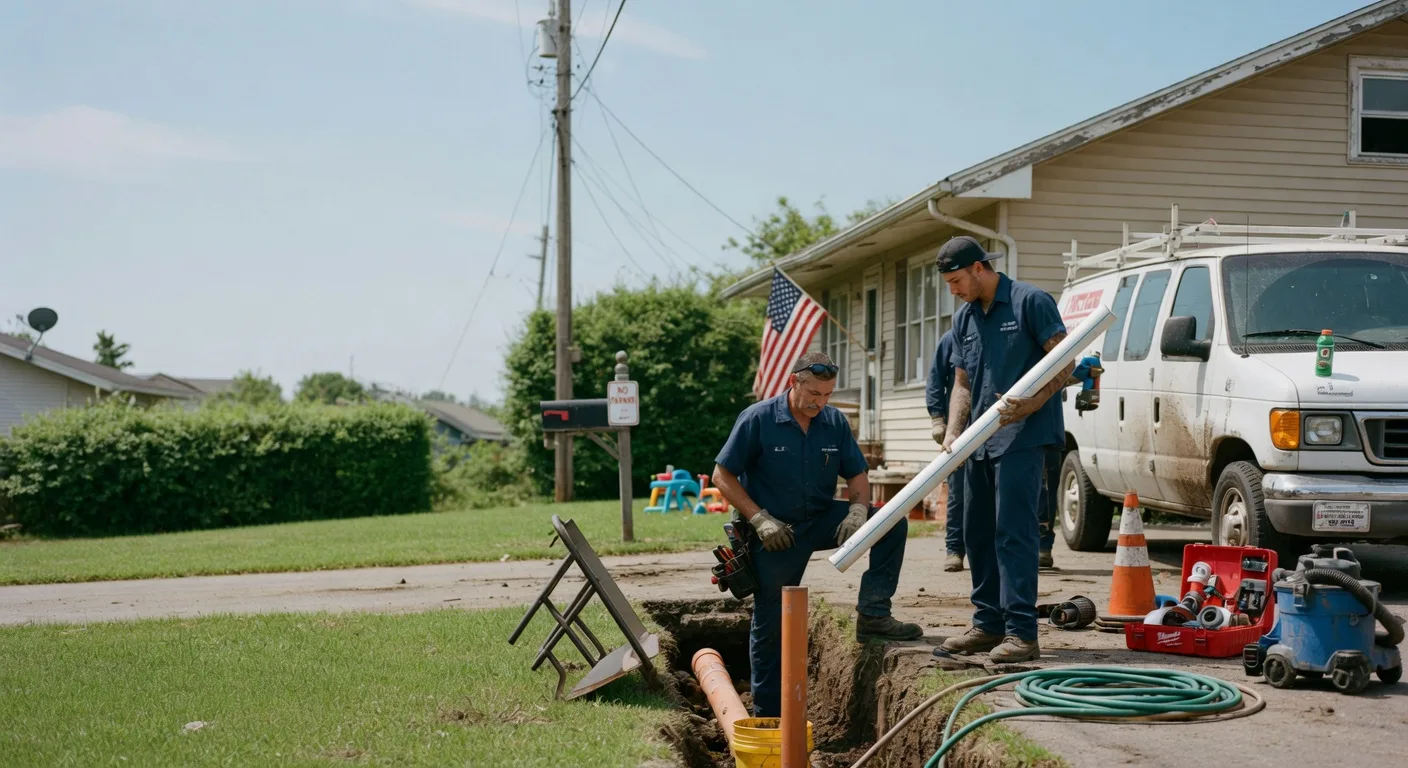
The city is replacing the street main outside our house. Why are our drains acting up now?
The crew has been digging up the street for a week, and now your toilets gurgle, the tub drains slowly, or you saw muddy water in a floor drain. It is natural to suspect the work outside. There are a few real reasons why it can be connected.
Your house drain, called the lateral, runs from your foundation to a connection on the city main. When the main is dug up and replaced, that connection is cut and reattached. Vibration, trench work and heavy equipment can crack an older clay or cast iron lateral, push a joint out of line, or shift the pipe so water now pools in a low spot. Dirt, gravel and construction debris can also wash into the line while connections are open. The work can also cause temporary backups while flow is being rerouted or the new pipe is flushed.
The key question is whether it is one fixture or the whole house. A single slow sink is probably the fixture. If every drain is sluggish, gurgling or backing up at once, particularly the lowest ones, the trouble is in the lateral or the main, and the street work is a likely suspect.
Safe homeowner check: write down when the symptoms began and compare that to when work started near your address. Take photos of any muddy water, debris or wet floor. Check whether neighbors have the same trouble. Run one tap for a minute and see if the lowest drain in the house reacts.
Stop running water and call now if sewage is coming up in a tub or floor drain, if there is standing water in the basement, or if you smell sewage inside the house. Do not keep using the washer or dishwasher.
Tell the utility or the contractor promptly. They may have a claims process, and a delay can make it harder to show when the damage started. A cable machine may be enough if loose debris is the problem. If the lateral is cracked, offset or holding water, the plumber will need a camera inspection to see the damage, and hydro jetting can flush out silt and gravel.
Expert Plumbers Co is a referral service. We connect you with an independent local plumber in Berger, MO. Call (380) 262-9173.
Ask the plumber to record the camera inspection and write down the footage location of any damage, so you can give it to the city or contractor. Scope depends on how deep the pipe is, how much has to be dug up or opened, parts and materials, and any permit or code requirement. Responsibility for the repair varies by area, so confirm who owns which section of the line.